Powerful sensing capabilities out of the box, with room to grow
What Tick can detect and monitor right out of the box
Persistent counters that survive power loss and reboots. Track events, cycles, pulses, or any activity. Counts are stored locally and synced to cloud.
Automatic detection and logging of power outages. Track uptime, know exactly when power was lost and restored, and get alerts on recovery.
Monitor signal strength and connection status across WiFi, cellular, or LoRa links. Historical data helps identify connectivity issues before they impact operations.
With an accelerometer sensor, detect when the device is moved, tilted, dropped, or tampered with. Protect assets that shouldn't be relocated.
Add a PIR sensor to detect people or animals passing by. Count foot traffic, monitor room occupancy, or create motion-triggered alerts and automations.
Set thresholds on any sensor value. Get notified when counts exceed limits, temperatures cross boundaries, or any condition needs attention.
No app downloads, no cloud dependency—access directly from your browser
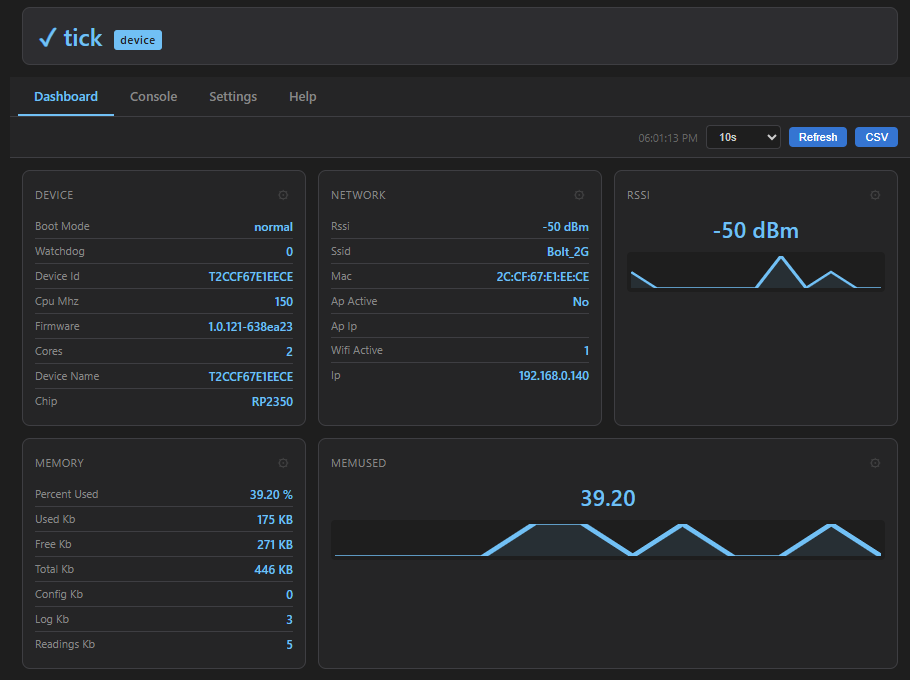
Real-time sensor readings with device info, network status, and memory usage. Live sparkline charts show RSSI and memory trends. Configurable refresh rates.
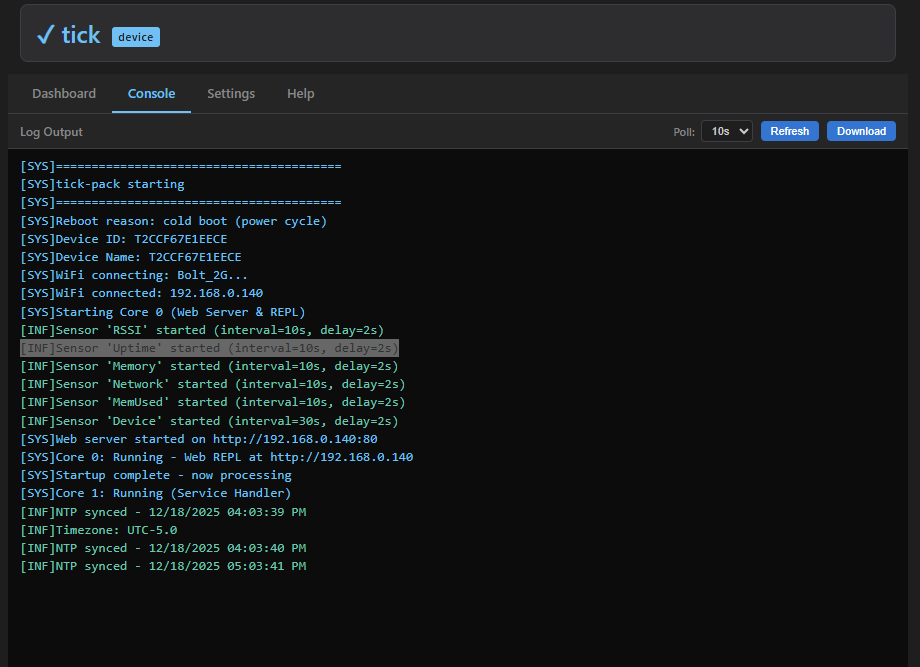
Live log viewer with color-coded messages. See startup sequence, sensor status, WiFi connection, and NTP sync. Built-in command REPL at the bottom.
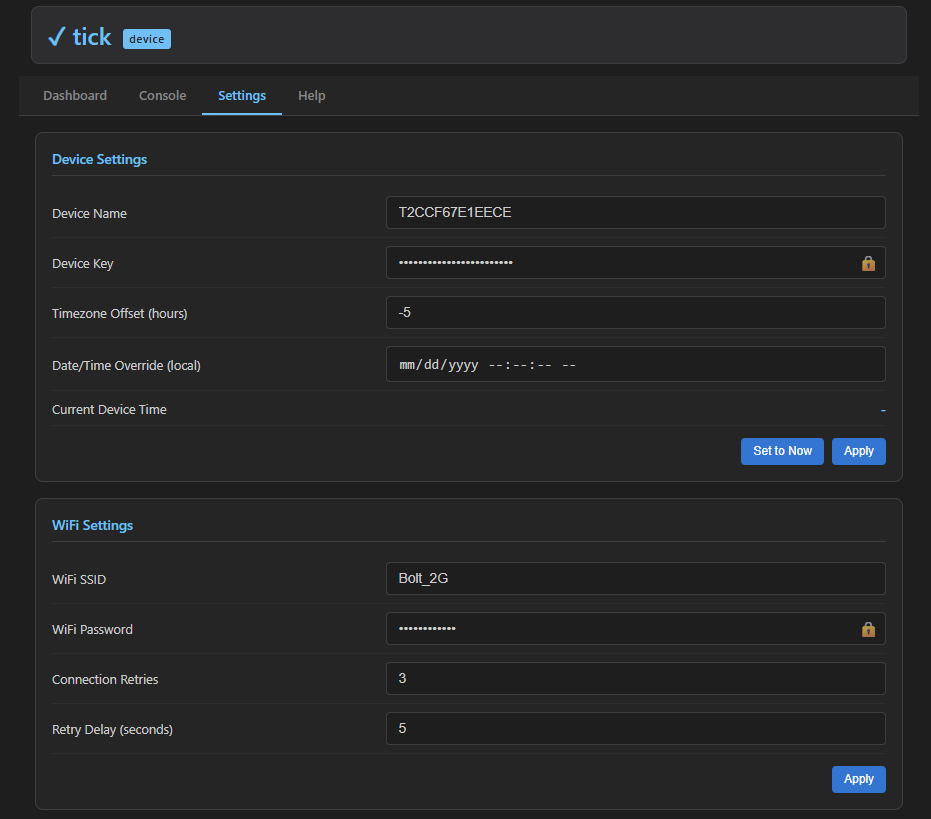
Configure device name, timezone, WiFi credentials, and log settings. Backup and restore configurations. All settings persist across reboots.
Optional Azure cloud connectivity for remote monitoring and fleet management
Azure Functions-based REST API for device communication. Push readings, receive commands, sync configuration—all over HTTPS.
Azure Table Storage for readings, logs, and commands. Scalable, cost-effective storage with built-in retention policies.
Browser-based UI for remote device monitoring. Same look and feel as local interface, accessible from anywhere.
Send commands to devices remotely. Commands queue until device polls, then execute with result confirmation.
Group devices into claims for organization. Broadcast commands to all devices in a group simultaneously.
Per-device authentication keys. TLS encryption for all cloud communication. No passwords stored on device.
I2C expansion supports hundreds of sensor types
* DS18B20 requires 1-Wire adapter. Contact us for custom sensor integrations.
Designed for unattended 24/7 deployments
Configurable watchdog timer (up to 8.3 seconds) automatically restarts the device if firmware hangs. Crash recovery without human intervention.
Configure automatic reboots after N hours of operation. Prevent memory leaks and ensure fresh state. Data syncs before reboot.
Automatic network time synchronization with configurable intervals. Accurate timestamps for all readings and logs, even after power loss.
Know exactly why your device rebooted: power-on, watchdog reset, soft reset, or hard reset. Debug issues with complete reboot history.
Device settings and counter values survive power loss. Critical configuration stored in flash. No data lost on unexpected reboots.
Built-in HTTP server on port 80. Check device status directly from any browser on your network—no cloud required.
Smart protocols minimize bandwidth while maximizing insights
Sensors report min, max, and sample count alongside current values. Get trend data without storing every reading. Reduces sync payloads by 50%+.
Compact binary format for sync and heartbeat payloads. Up to 255 sensors with 8 fields each in a single efficient packet.
Minimal status signal includes uptime, memory, RSSI, error count, and firmware version. Know your device is alive without full data sync.
Independent polling and sync intervals per sensor. High-frequency for critical values, low-frequency for slow trends. Balance accuracy vs bandwidth.
Only changed configurations pushed from cloud. Device applies updates incrementally without full profile reload.
Readings buffered locally during network outages. Auto-retry with exponential backoff. No data lost on temporary disconnections.
Complete observability and control for builders
Status, sensor reads, service control, reboot, config, sync, logging, time—all accessible via console or cloud. JSON output for scripting.
JSON configuration files define sensors, services, and intervals. Inherit from base profiles. Deploy configs without firmware changes.
Device logs upload to cloud with SYS/ERR/INF/DBG levels. Sequence numbers and trace IDs for correlation. Debug remotely without physical access.
Queue commands from cloud dashboard. Device polls and executes with output capture. Up to 10KB response per command.
Update firmware over-the-air via cloud command. No physical access required. Deploy updates across your entire fleet.
Configurable units (°C/°F, metric/imperial). Local timezone support. Human-readable output or JSON for parsing.
Connect locally or remotely—Tick works with your existing systems
RESTful endpoints accessible on your local network. Query sensor data, send commands, and configure settings without cloud dependency.
Azure-based REST API for remote access. Push readings, receive commands, and manage devices from anywhere with internet access.
Trigger external systems on events. Send alerts to Slack, update databases, or integrate with automation platforms.
All data exchanged in standard JSON. Easy parsing for any programming language or integration platform.
Connect to Home Assistant, IFTTT, The Things Network, and other cloud platforms. Trigger automations and sync data across systems.
Complete API reference with examples. Everything you need to build custom integrations.