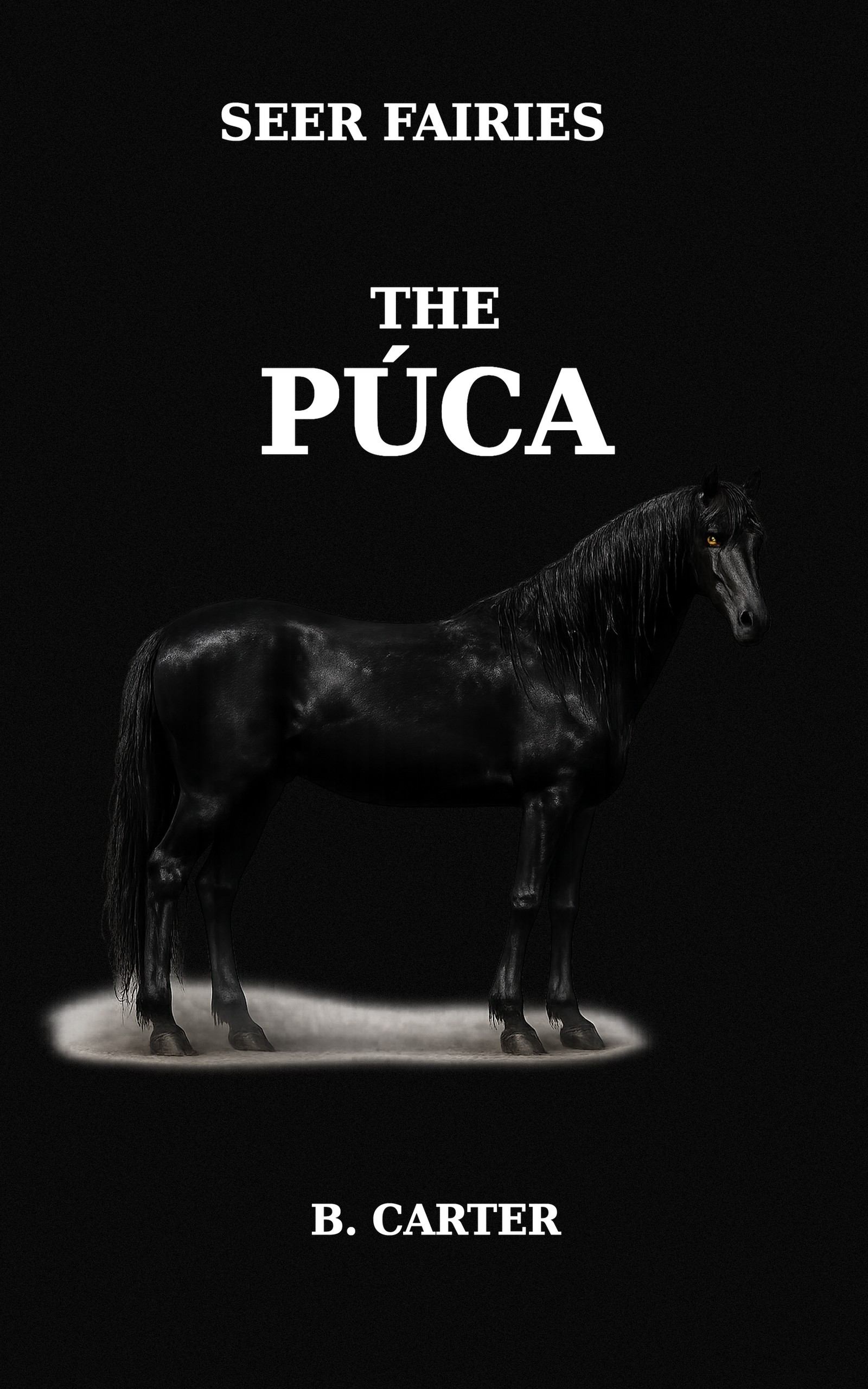
Something is wrong at the crossroads in Hollow Creek, West Virginia. The light is half a shade too warm. The air smells like peat smoke, and there is no peat within three thousand miles. A black horse with gold eyes stands at the junction where three roads meet and watches a thirteen-year-old boy ride past on his bike.
Eli Morrow wears his father’s navy hoodie every day. The hoodie is too big. His father left for a construction job in Charlotte two years ago. Six months, he said. The Sunday calls are getting shorter. The truck has not come back up the mountain. Everyone in Hollow Creek knows. Eli’s mother knows. Eli knows, underneath, in the place he does not look.
The púca does not create truth. The púca removes the last wall between you and the truth you have been refusing to see. And the púca has just arrived in a country that has no tradition of containing it — no crossroads lore, no blackberry rules, no village memory. It is hungrier here than it has ever been in Ireland.
A woman with cold hands arrives in town on October 22nd. She calls herself the Seer. She has felt the pull point to West Virginia for the first time in her life, and she knows what the pull means.
The horse was standing at the crossroads when Eli came around the bend on his bike. Not on the shoulder. In the middle. Where the three roads met.
Eli braked. The tires skipped on the gravel and the bike slid sideways a half foot before it stopped.
The horse did not move.
It was black. Not dark brown, not the almost-black that most black horses actually are — the real black, the black of a thing that absorbs light instead of reflecting it. Its mane was long and the wind was not moving it. Its tail hung straight down.
Its eyes were gold.
Not yellow. Not brown with a yellow ring. Gold. The color of a coin. The kind of gold that does not exist in the eyes of any animal Eli had ever seen or heard of or been told about. The gold glowed faintly, even in the afternoon light, the way a phone screen glows when you hold it up in a dark room.
The horse looked at him. The looking was the thing. It was not the dumb attention of an animal noticing a moving object. It was the attention of something that had been waiting for him specifically.
Eli’s hands went to the hood of the hoodie and pulled it up.
Field Notes — The Púca
What it is: An Irish shape-shifting predator. Appears most often as a sleek black horse with golden eyes that offers rides you cannot survive. Also a black goat. Also a dark-haired man with pointed ears and a smile that has too many teeth. The golden eyes are the tell: they persist across every form.
How it picks you: It sees the lie you tell yourself. The thing you already know but refuse to name. The wall you built and maintain and live behind. The púca is drawn to unclaimed truth — what you have been refusing to say out loud.
How to spot it: The gold in the eyes cannot be fully concealed. Firelight, lamplight, a phone screen in a dark room — the gold will show. Also: the air will smell like peat smoke in places that have never burned peat. Also: it stands at crossroads.
How to survive it: The púca cannot lie. Every word it speaks is true. If you can take three hairs from its mane or head, you have one demand it must honor — but getting the hairs requires surviving the proximity. The compact that Brian Boru, High King of Ireland, struck with a púca is the only one ever to hold.
What it costs if you get it wrong: The truth you were avoiding, delivered from the angle that cuts. The horror is not learning something new. The horror is being forced to see what was always there.
Who’s Who
Eli Morrow
13. Small for his age. Wears his father’s navy hoodie every day — the hoodie is too big, and the oversize is the point. The hoodie is the last wall. When the hood comes down, Eli is exposed.
Sarah Morrow
36. Eli’s mother. Works the Dollar General in Lewisburg, drives an aging Chevy Malibu thirty minutes each way on mountain curves. Has carried the knowledge of Kyle’s leaving silently for eighteen months. The scaffolding is exhausted.
Jess Kovac
14. Eli’s friend. A year ahead of him and two inches taller, which she mentions weekly. The practical one. Doesn’t scare easily. The púca scares her.
Mrs. Kovac
81. Jess’s grandmother. Born in County Clare, Ireland. She carried the tradition across the ocean the way she carried her mother’s rosary in her pocket. The only person in Hollow Creek who knows the rules — and who knows that a púca in West Virginia means a door has opened where it was never supposed to open.
The Púca
A black horse with gold eyes. A black goat. A dark-haired man whose smile has too many teeth. It cannot lie. It sees through every wall a person builds against the thing they already know. It is bound to the crossroads, and the crossroads are its seat.
The Seer
Cold-handed. Quiet. Has followed the pull across continents to places where fae belong. This is the first time the pull has pointed to America. She cannot prevent what is coming. She can ensure Eli understands what the púca is, what the rules are, and what the cost will be.
The gold in the eyes is the tell.
This site uses essential cookies for basic functionality. Non-essential cookies (analytics, preferences) are only set with your consent. See our Privacy Policy.