Seer Frights
Hollow Creek Road ends at a fence. Past the fence is swamp. Nobody goes past the fence.
Noah Marshall does.
Three kids. Brand-new shoes. One dare that sounds easy and isn't. When Noah convinces his friends to climb the fence and cut through the swamp, they expect mud, bugs, and maybe a story to tell at school on Monday.
What they find is something wrong. Lights that glow where no lights should be. Chickens that don't move. A house on stilts at the end of a trail that shouldn't exist. And an old woman named Mrs. Calhoun who knows their names before they say them.
The deeper they go, the more they lose. Their shoes. Their way back. Their certainty about what's real. And by the time they figure out what Mrs. Calhoun is actually doing in that swamp — it might be too late to leave.
. . .
The last person to go into the swamp had carved three words into a cypress trunk before they stopped carving anything at all.
SHE WATCHES
That was in 1987. The letters had darkened with sap and age. Moss was filling them in, soft green fingers pressing into each groove, and in another ten years the bark would close over them completely and the warning would be gone. Nobody has ever listened to the warnings.
Before dawn, the swamp was quiet. The wrong kind of quiet. Not empty. Held. The kind of silence that happens when every living thing in a half mile has stopped breathing at once and is listening to something you can’t hear yet.
Mist drifted low across the black water, threading between cypress trunks, settling into the roots. No wind. No frogs. No insects sawing in the dark. Just the swamp, and the smell of it: rich black mud, and underneath that something sweeter, something that didn’t belong in a place where things rotted. The sweetness of something alive, breathing out, slow and patient.
Then the animals came.
Not the way animals come to water at dawn. Not to drink, not to hunt. They came the way people file into a viewing. Quiet, single-file, nobody making eye contact. Ducks first, gliding out of the fog in a silent line. Muskrats next, climbing onto roots without a splash. Rabbits. A heron. A possum. All converging toward the same place: a clearing in the deep canopy where a low wooden structure sat on a patch of dry ground, its door hanging on a single hinge.
A chicken coop. Old enough that the wood had turned the color of bone.
Inside, on a rough feeding table, a leather-bound book sat closed. Its cover was darkened with age, the leather worn smooth at the corners the way leather gets after a hundred years of handling. But it wasn’t cracked. It wasn’t rotting.
It sat in the middle of a swamp, in a building with walls that didn’t keep out water, and it was dry. It had always been dry. The swamp didn’t touch it. The damp didn’t reach it.
As if the book and the water had an understanding.
The water at the edge of the clearing rippled. Once. The way water moves when something large shifts its weight beneath the surface. Then it went flat. Perfectly, impossibly flat. Not still. Flat. As if the surface had been pressed smooth by a hand from below.
A faint green glow drifted between the trees. Not a reflection. Not swamp gas. A light. Weaving through the trunks, low over the water, tracing the same patient route it had been tracing since before the fence existed, since before the road existed, since before the houses pushed up against the edge of something they should have left alone.
On the sagging roof, four black chickens sat motionless. Their dark eyes were fixed on the place where the glow had been. They didn’t cluck. They didn’t shift. They had been sitting there when the last kids came through. And the kids before that. And the ones before that. The same four chickens, on the same roof, in the same positions, for longer than any chicken lives.
Meet the kids who climbed the fence.
The one who climbed the fence first. White t-shirt, cargo shorts, brand-new Biggs Uptown 1s he was not supposed to be wearing. Always has a plan. The plan usually starts with "What if we just…"
The one who said they shouldn't go. Hoodie, lavender Fenton Dashes her dad saved up two months to buy. Smartest person in any room. Hates being right about danger almost as much as she hates asking for help.
The one who went anyway. Red Rockets cap, dark hoodie, limited-edition Halcro Jets his grandma waited two hours in a lawn chair to get. Cracks jokes when he's scared. It works better than you'd think. Braver than he knows.
The old woman in the weathered house on stilts at the end of Hollow Creek Road. Has a cat named Pickles. Knows things about the swamp she doesn't share.
Black. Enormous. Unnervingly still. They don't cluck. They don't scatter. They just watch.
It was here before the houses. Before the road. Before the fence. It will be here after. It does not like visitors. Or maybe it likes them too much.
Mist curled low between the trees, and twice he thought he saw that greenish glow again, hovering low in the fog ahead of them. Faint and pale, like light bleeding through murky glass. Gone the moment he looked directly at it. Noah didn’t mention it, because saying it out loud would make it real.
Lily stopped. “Do you hear that?”
Noah and Jake froze.
Silence. The kind of silence that has weight — that presses against your eardrums and makes you hold your breath without meaning to.
“I don't hear anything,” Noah said.
“Exactly.” Lily's voice was barely a whisper. “That's what's wrong. Swamps are supposed to be loud. Frogs, bugs, birds. But there's nothing. It's like everything in here is… hiding.”
A chill ran through all three of them at the same time, like a cold hand brushing the backs of their necks.
Then, from somewhere deep in the swamp, they heard a splash.
Something big. Something heavy. Like a person dropping into the water from a height.
“What was that?” Jake whispered.
Nobody answered.
The splash didn't come again. But now the silence felt different. It felt like something was listening.
The Swamp Glow — Mrs. Calhoun's green pucks that sit in the mud and glow like something alive.
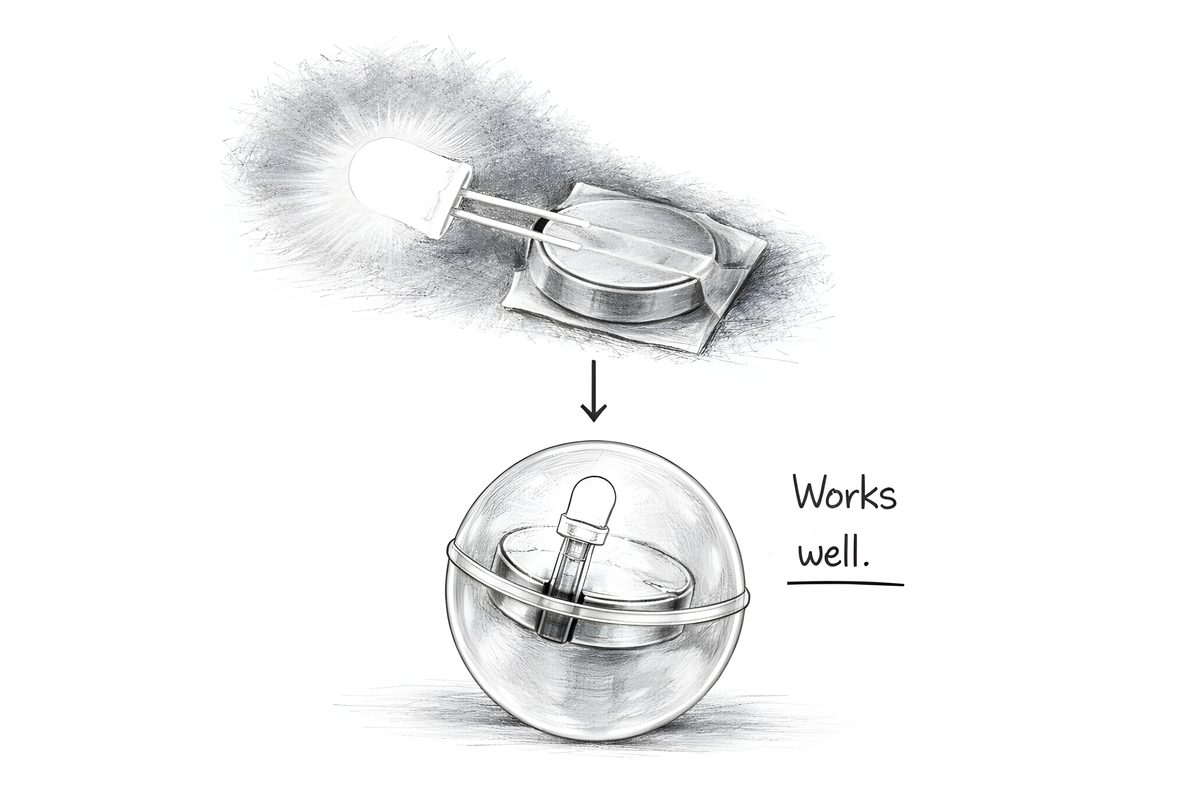
If you can use tape, you can make this.
Parts — where to buy each one →
Step 1 — The LED. It has two legs. The long leg is positive (+). The short leg is negative (−). That's the only thing you need to remember.
Step 2 — The battery. The flat side with the + is positive. The bumpy side is negative.
Step 3 — Sandwich. Long leg on the flat side (+). Short leg on the bumpy side (−). It lights up. That's the whole circuit.
The LED only lights when both legs are touching the battery — positive and negative connected at the same time, forming a complete loop. Electricity only travels around complete paths.
Step 4 — Tape it. Wrap electrical tape around the battery and legs to hold it together.
Doesn't light? Flip the LED around — it might be backward. Still nothing? Check that the tape is pressing both legs firmly against the battery.
Tuck the whole thing inside any clear ball — plastic ornament, capsule toy shell, clear Easter egg. Seal it, frost it with sandpaper, done. Green LED inside a frosted ball looks swampy without paint.
Want a switch? A tiny slide switch between the long leg and the battery. Slide on, it glows. Slide off, it stops.
Safety: Keep coin batteries away from small children — they're a choking and ingestion hazard.
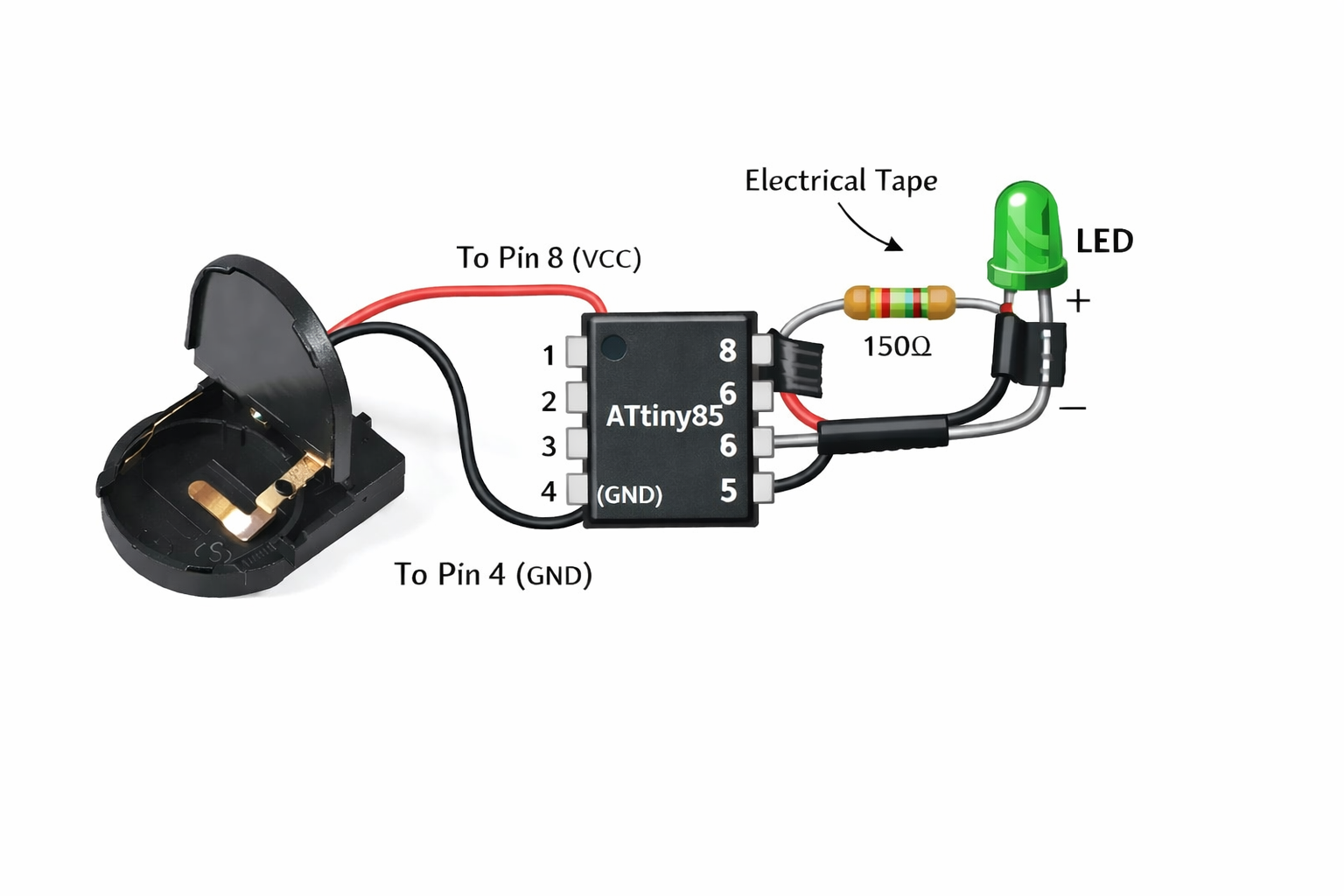
Same green LED, same housing — but now you control the pattern. A tiny chip smaller than a dime tells the LED what to do.
Parts — where to buy each one →
Hold the chip so the small notch or dot faces left.
Bottom-left is Pin 1. Top-left is Pin 8. Pins count counter-clockwise.
Use a Tiny AVR Programmer board (~$17) — plug the ATtiny85 into the socket, plug the board into USB, and upload a short program from the Arduino IDE. One time. After that, the chip remembers.
int onMinutes = 120; // minutes LED stays on (120 = 2 hours)
int offMinutes = 10; // minutes LED stays off
void setup() { pinMode(0, OUTPUT); }
void loop() {
digitalWrite(0, HIGH);
for (long i = 0; i < (long)onMinutes * 60; i++) { delay(1000); }
digitalWrite(0, LOW);
for (long i = 0; i < (long)offMinutes * 60; i++) { delay(1000); }
}
Three connections. No soldering. Bend the resistor legs and LED legs directly onto the chip pins — they're long enough.
Tape it together with electrical tape. The battery holder has a built-in on/off switch.
Same as Version 1 — tuck it in a clear ball, seal it, frost it, done. The ATtiny85 is small enough to fit in a golf ball with the coin battery.
Doesn't light? Check LED polarity (long leg to resistor side). Check resistor is between pin 5 and the LED, not bypassed. Check battery is seated. Try flipping the LED.
The soft kind — not the bright clear ones. Diffused LEDs scatter the light so the whole puck glows evenly. 100-pack, about $0.06 each.
The flat silver one. 3V. Available at any drugstore, grocery store, or online. About $0.45 each in a 20-pack.
Black electrical tape. Holds the battery and LED legs together. Any hardware store or dollar store.
Clear capsules that split in half. 2-inch size — perfect for the coin battery build. 50-pack for $19.79.
Optional. Seals the ball seam for waterproofing. Skip if you're not putting it in water. Must be 100% silicone, no anti-mildew additives.
Optional. One coat makes the clear ball look swampy. Without it, the LED still glows green through the clear plastic.
Optional. 220-grit or higher. Roughing up the ball frosts the surface and scatters the glow. Works without it, but looks better frosted.
Building Version 2? You still need the LED, CR2032 battery, ball, and housing supplies from Version 1, plus these extra parts. No soldering required.
ATTINY85-20PU. Tiny 8-pin microcontroller — program it once, it remembers forever. Runs on 2.7–5.5V. 5-pack for $13.99 — gives you spares.
USB programmer board with a built-in socket. Plug the ATtiny85 in, plug into USB, upload from the Arduino IDE. $16.99.
LED current limiter. 1/4 watt. Brown-green-brown color bands. 100-pack for $5.49.
Snap-in holder with red (+) and black (−) wires and built-in on/off switch. Red wire to VCC (pin 8), black wire to GND (pin 4). No extra hookup wire needed. 6-pack for $5.59.
Third-party sellers set their own prices, shipping, and policies. See our Terms of Use for details.
On stakes in the mud. Wedged into tree roots. Sitting on stumps. Drop them right into shallow water — the housing holds tight enough to sit submerged for hours. Those ones make the water itself glow from underneath. Looks like something's down there, looking up.
The glow should look alive. Not electronic. Not a flashlight. Alive. Like the swamp is watching you back. If it looks like a gadget, you did it wrong. Sand the shell. Rough it up. Let it sit in the mud for a day. It should look like something you found, not something you bought.
KITS
Don’t want to hunt for parts? Kits are underway and will be available soon.
"We saw it . . ."